
Blog
Catfly AI Review: From One Idea to a Published Mini-Game
A screenshot-backed review of Catfly AI's game generation, asset library, browser playtesting, community, and multi-channel publishing workflow—with clear limits on what is not yet verified.
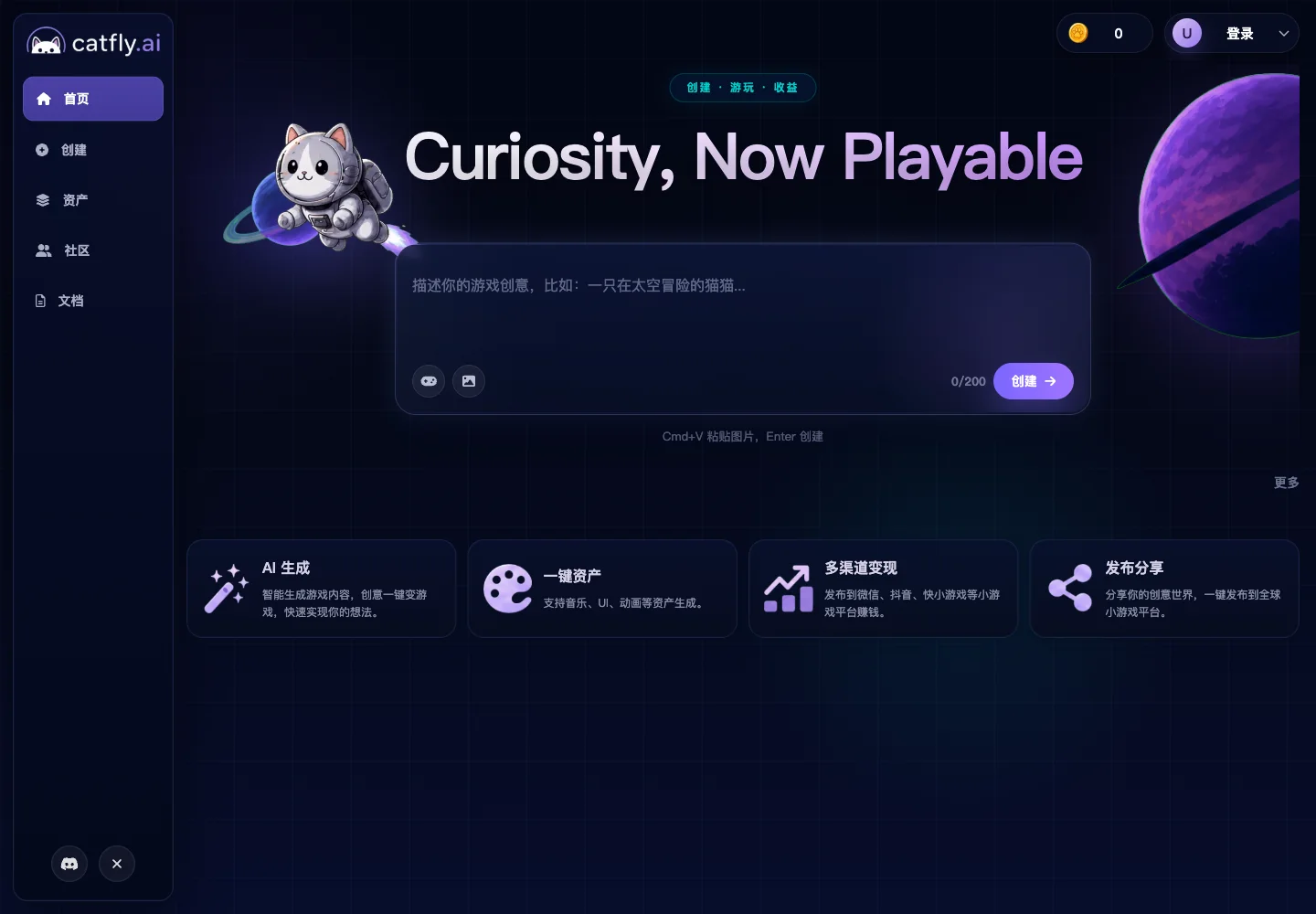
How this review was conducted
We visited the official Catfly AI website on August 21, 2026 and inspected its public Home, Create, Assets, and Community pages. Every product screenshot in this article is a real desktop capture from that session. The workflow graphic is our own explanatory diagram based on the public interface.
We did not sign in, buy credits, or run a generation task. This is therefore a public product and workflow review, not a full generation benchmark. Claims shown by Catfly are kept separate from capabilities we could independently verify.
What is Catfly AI?
Catfly AI is an AI mini-game creation platform that still carries a Beta label. Its public positioning—“Curiosity, Now Playable” and “Create · Play · Earn”—describes a path from a game idea to generated assets, browser playtesting, sharing, and distribution.
The home screen reduces the proposition to four cards: AI generation, one-click assets, multi-channel monetization, and publishing. Unlike a general coding agent, it begins with the game a user wants to make rather than a repository or file tree.
The core workflow: idea to distribution
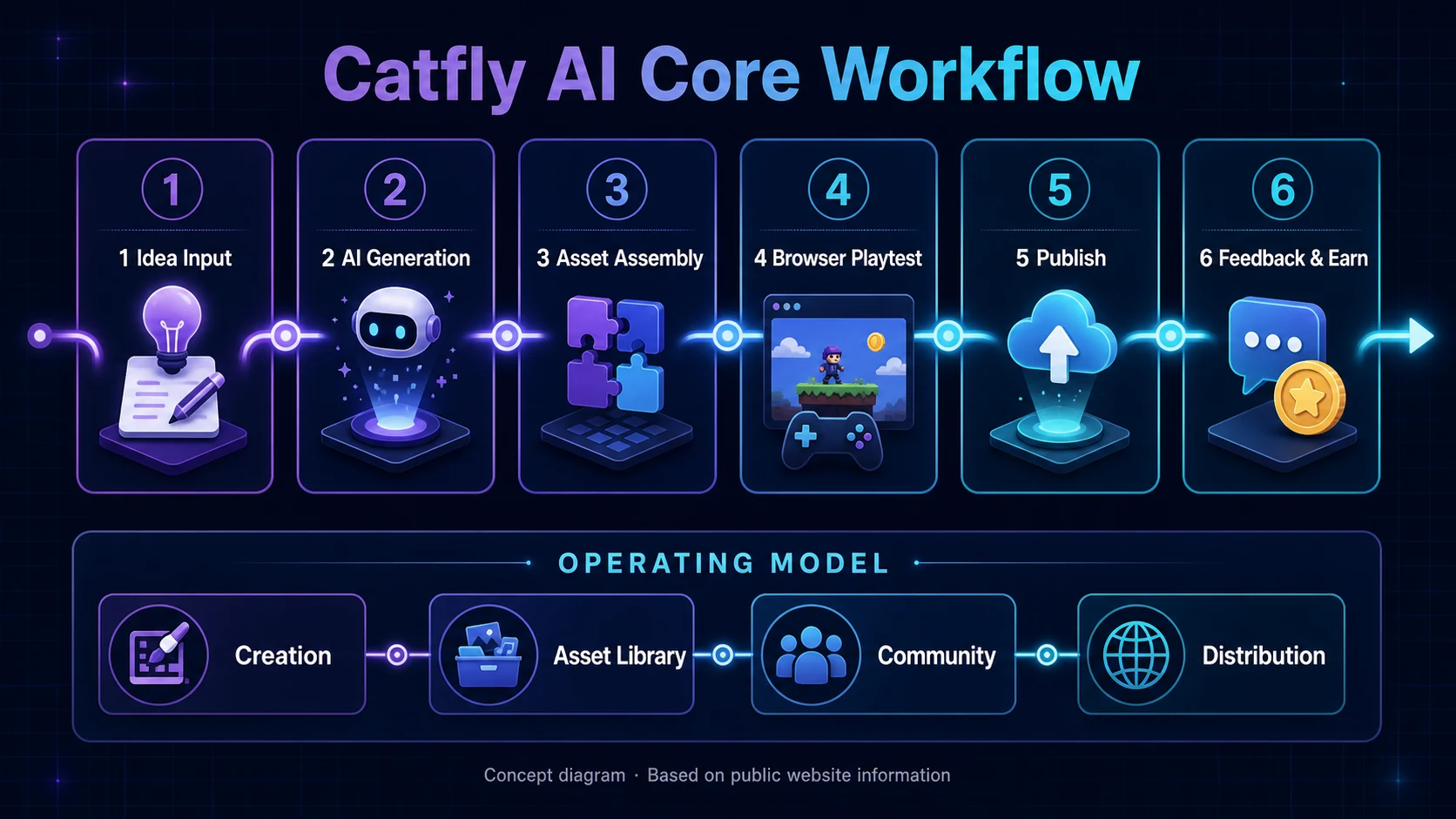
Independent concept diagram based on Catfly AI's public website, not an official internal architecture diagram.
1. Idea input: a short prompt plus two kinds of reference image
The Create page keeps the starting point deliberately simple: a description of up to 200 characters and separate controls for gameplay and art references. That separation makes sense. A single image rarely communicates both rules and visual direction well, so treating them as different inputs should reduce ambiguity.

Catfly AI Create page, captured August 21, 2026. The logged-out view reveals the input structure but does not permit a generation test.
This is well suited to a concise core loop: character, objective, failure condition, and art direction. The 200-character limit also means that economies, multi-level logic, or long narratives will probably depend on later iterations. The public pages do not show that iteration experience in enough detail to assess it.
2. AI generation: the promise is game content, not a static image
Catfly says it turns ideas into game content. The meaningful test is stricter than whether a page opens:
- Does the core mechanic match the prompt?
- Can a creator make a local change without regenerating everything?
- Are failed tasks, missing assets, and runtime errors explained and recoverable?
The logged-out experience does not answer those questions, so this review does not turn “AI generation” into a claim of production-grade reliability.
3. Asset assembly: games, UI, art, and music are first-class categories
The Assets page separates Games, UI, Art, and Music, with search, task status filters, and history. This signals that Catfly wants a reusable project layer, not a one-shot prompt result.

The asset taxonomy and status controls are publicly visible; editing, versioning, and export still require a signed-in test.
This is the right direction. AI game creation often becomes difficult after the first draft: replacing music without changing pacing, updating UI without breaking mechanics, or restoring a previous asset. The public interface proves that categories exist, but not yet that dependency management, history, or bulk replacement are mature.
4. Browser playtesting: acceptance happens by playing
“Create · Play · Earn” puts playtesting in the middle of the product story. For a non-programmer, that is more useful than a list of generated files. Movement, goals, difficulty, and failure states have to be felt.
The public site did not expose an anonymous generated game or playable sample during our session. Load time, mobile input, audio behavior, orientation support, and crash recovery therefore remain essential pre-purchase tests.
5. Publishing and distribution: mini-game channels are part of the pitch
The Chinese interface explicitly names WeChat, Douyin, and other mini-game channels, while describing one-click global publishing as the target experience. That positions Catfly closer to production and commercialization than a simple web-game generator.
“Supports publishing” does not mean a store review will pass, and it is not an earnings guarantee. Package limits, channel SDKs, advertising and payment integrations, privacy requirements, rejection handling, revenue share, and settlement rules determine commercial usefulness. Those details are not fully disclosed on the public pages we reviewed.
6. Community feedback: a tool can become a creator network
The Community page includes Discussion, Showcase, and Feedback categories. Together they can support discovery, creator help, product feedback, and acquisition.
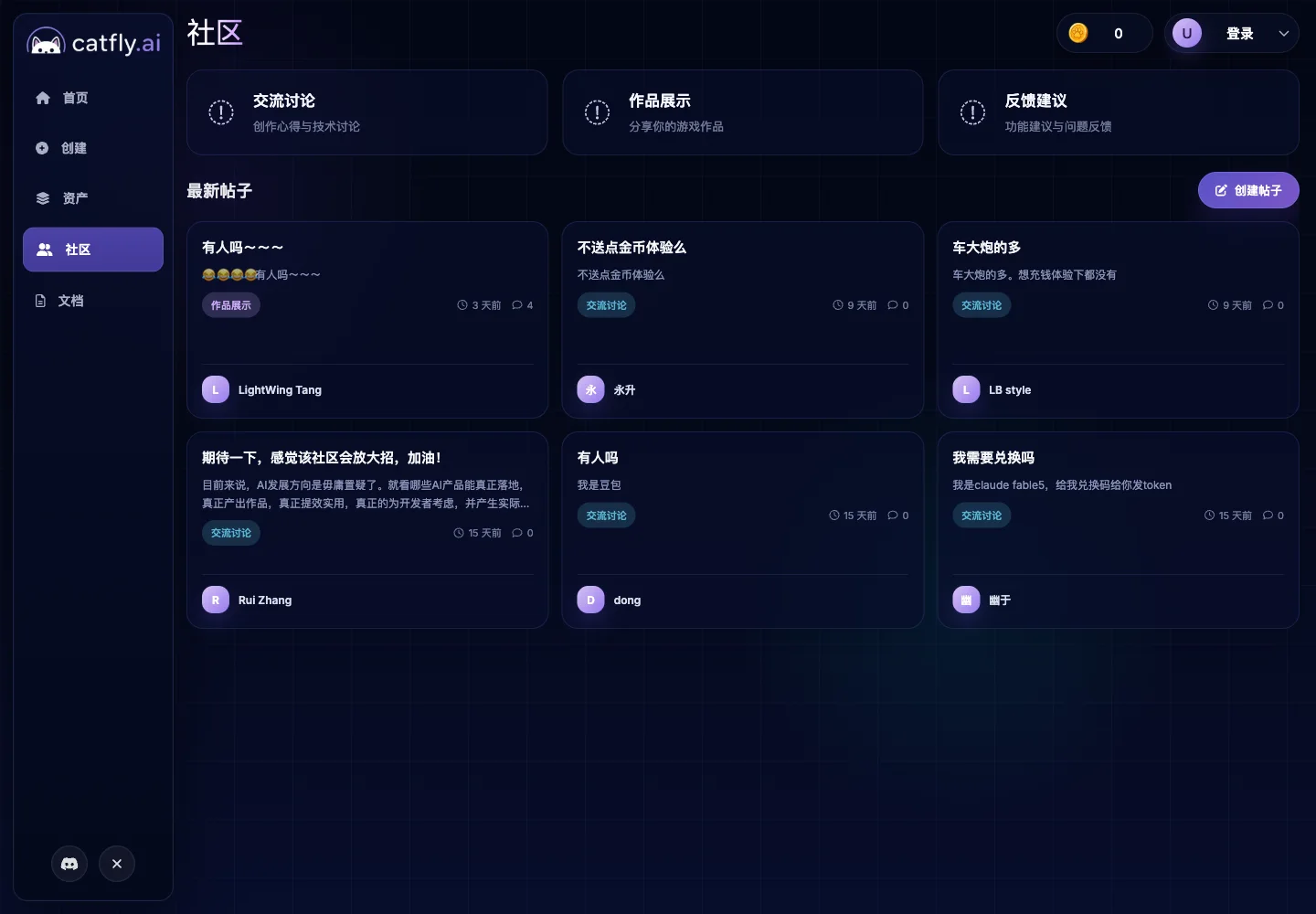
Catfly AI's public Community page. User posts are public contributions, not official product commitments.
The page contains real user activity, including questions about coins, top-ups, and access. That is useful early demand evidence, while also suggesting that onboarding and credit explanations could be clearer. This is a product-experience inference, not confirmation of Catfly's billing policy.
The operating model is more than a Generate button
From the user-visible layer, Catfly can be understood as four connected modules:
- Creation collects prompts and references and starts a game task;
- Asset Library organizes games, UI, art, music, and task state;
- Community supports showcases, discussion, and feedback;
- Distribution aims to send work to mini-game platforms and create a path to revenue.
The strategic idea is to turn a generation event into a loop: ideas become managed assets, playtest feedback drives changes, and post-publication feedback starts another round. This is a user-side operating model inferred from the public interface, not reverse engineering of Catfly's models, code generator, or infrastructure.
What Catfly gets right
A focused product boundary
Catfly does not present itself as an AI platform for every software category. Its inputs, asset model, and distribution story are specific to mini-games. Focused generators have a better chance of developing useful defaults for one job.
Assets are not an attachment to chat
UI, art, and music are promoted to top-level categories. That is closer to a real production workflow and leaves room for reuse, replacement, and versioning.
Publishing appears on the first screen
Many AI tools stop at “it runs.” Catfly begins talking about channels and revenue on the home screen. The implementation details still need proof, but the product goal is clear.
A consistent, low-friction interface
Home, Create, Assets, and Community share the same sidebar, dark grid, and violet accents. Users are not pushed through disconnected tools with different interaction models.
The questions that still need answers
- Generation quality and time: success rate, first-playable latency, and credit treatment for failures;
- Iteration and versions: targeted changes, rollback, and side-by-side comparisons;
- Code and asset rights: source export and commercial rights for generated assets;
- Cost transparency: coin consumption, public plans, refunds, and usage estimates;
- Publishing responsibility: who owns channel adaptation, review, SDKs, privacy, and settlement;
- Production safeguards: collaboration permissions, deletion, uptime, support, and service commitments.
These are not proof that Catfly lacks a capability. They are simply not answered by the public, logged-out experience.
Who is it for?
Catfly currently looks most relevant to independent creators validating a mini-game idea, content or marketing teams testing interactive concepts, and non-technical users who prefer prompts and references to learning an engine first.
If a project requires source ownership, complex collaboration, deterministic channel compliance, or a committed launch date, run a low-risk pilot before moving the full production workflow into the platform.
Final assessment
Catfly AI already looks more complete than a prompt-to-demo toy: the creation entry is clear, the asset layer has structure, playtesting and distribution sit on one path, and the community is receiving real feedback. Its most promising asset is the mini-game-specific workflow, not any single AI feature.
For now, our assessment is: a focused Beta worth prototyping with, but not yet a production platform that can be judged from marketing pages alone. The best evaluation is a measurable pilot—use a fixed prompt and references, record time and coin usage, request three local changes, then export or publish to one non-critical channel. That evidence will be more valuable than any homepage slogan.